


- It Was Really The Children Themselves Who Decided It
- The Seven Guiding Principles
- Principle 1: The Play Therapist Does Not Need to Be a Skilled Player to Utilize Minecraft in Play Therapy
- Principle 2: The Therapy Starts Even Before the Game Is Played
- Principle 3: The Play Therapist Is Not Playing Minecraft for Their Own Enjoyment; They Are Playing to Be in the Experience of the Game with the Child
- Principle 4: The Play Therapist Can Model How to Work with the Stimulation in the Game to Help the Child Learn More About Themselves While Playing
- Principle 5: How the Game Ends in a Session Is Practice for Endings and Transitions Outside of the Play Therapy Space
- Principle 6: Parents and Helping Adults Can Support Their Child in Having a Therapeutic Experience with Minecraft at Home by Being Curious and Learning About the Game Together
- Principle 7: The Benefits of Playing the Game Reach Far Beyond the Play Therapy Space and the Digital World of Minecraft
- Minecraft is Another Creative Modality to Help Find Meaning
Brian W. Keating, MA, LPC (he/him), is a Certified Synergetic Play Therapist and Certified Group Psychotherapist based in Colorado, USA. He specializes in working with children and adults who have experienced adverse childhood experiences. Brian is also trained in EMDR, Attachment-Based Family Therapy for Depressed Adolescents (ABFT), and Intensive Short Term Dynamic Psychotherapy (ISTDP).
Brian has developed a globally recognized niche in tele-play therapy and digital game-based interventions, specifically integrating Minecraft into play therapy. He authored Adventures in the Digital Playroom: The Seven Guiding Principles for Using Minecraft in Play Therapy and contributed the chapter “Diving into the World of Online Play Therapy” to Advances in Online Therapy: Emergence of a New Paradigm. He enjoys presenting on these innovative topics and continuing to connect with others advancing the field. When not working, Brian is a professional bass player in a Motown tribute band.

It Was Really The Children Themselves Who Decided It
How did you decide to use Minecraft in counselling with children?
It was really the children themselves who decided it. When I began working online during the pandemic, the topic became more integrated in the relationship as clients were often playing right before our appointment or planning to play after. They would naturally talk about what they were doing with the game and how they were playing. I’m always interested in what is important in the lives of the client, but how there were talking about the game hit differently.
I noticed how body language and energy levels would shift simply describing how invested they were in the game. It eventually made sense for them to show me builds they were proud of or how they were managing a survival world. I became more invested when I noticed the impact in real time. When a child was showing me an elaborate structure they built, including items that were important to them, it led to a natural exploration of how those items might relate to what they also have access to at home.
While it was helpful to be an observer, I wanted the more immersive experience of joining them. I was using other digital online games such as UNO, Battleship, Pictionary, and many others so this became another option. Some clients also wanted to play popular games within Roblox, or Fortnite, and Legend of Zelda Breath of the Wild (among many others) — and while a similar therapeutic approach can be taken with those games — Minecraft stood out as the one that most aligned with my clinical orientation.
Why Minecraft?
I had heard about Minecraft casually but had never played myself. As I learned more about it directly from my child clients, I realized how similar it was to the physical toys I was missing from being in my play therapy office. Especially during the first month of the pandemic.
Perhaps like so many others at the time, I thought I would only be online for a few days or a week at the most. As the weeks went by, I realized I needed something to replace the items in my physical office: a sand tray, figurines, competitive games, costumes, characters with superpowers etc. As I learned more about Minecraft I became familiar with how uniquely suited the game can be in terms of replicating many of the items in a playroom. In all senses of the phrase, it really became my “digital playroom.”
In fact, when it came time to decide whether I wanted to renew the lease on my physical office, I chose not to — I had almost everything I needed with Minecraft. While games like Breath of the Wild and Animal Crossing are immensely therapeutic and can share similar qualities, Minecraft was the total package for me.
The Seven Guiding Principles
In your book, you introduce the Seven Guiding Principles: A Therapeutic Framework for Using Minecraft in Play Therapy. Could you briefly tell us about them?
The Seven Guiding Principles naturally evolved as I began to share my work with colleagues. I noticed themes arising in the questions and conversations about the challenges and focus of doing this work. As I prepared for presentations, I found myself outlining the material in a specific way to get ahead of the questions I anticipated. At the time I was also sharing my experience with colleagues that were not as familiar with using video games, doing online play therapy, or were generally new to the field. I believe that this audience helped me focus what I felt was important to convey as a way of instilling confidence in the intervention as well as in the clinician providing it.
As you consider these you may notice how the progression evolves from the first principle through the seventh.
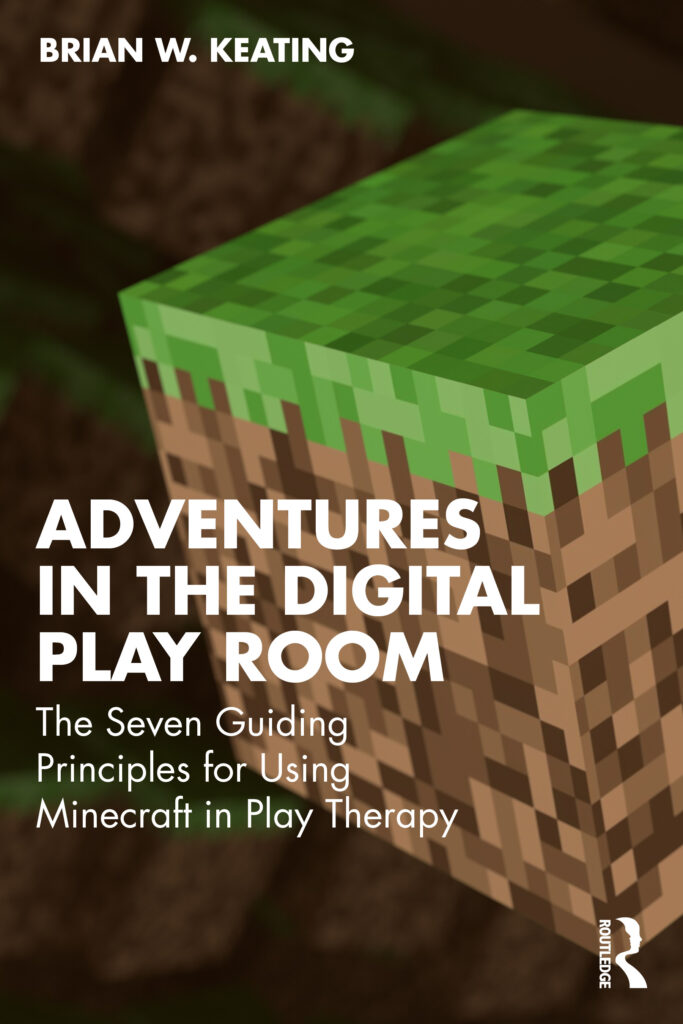
Principle 1: The Play Therapist Does Not Need to Be a Skilled Player to Utilize Minecraft in Play Therapy
This first principle offers the permission for all helping adults to engage in play without the expectation that they must be “good” to be helpful. I didn’t realize this at the time of writing the book, but it can also apply to our clients — the game is just as helpful for the clients that are experienced players as well as the ones who are playing for the first time in our sessions.
Principle 2: The Therapy Starts Even Before the Game Is Played
This is an important reminder that we are always in relationship with our clients regardless of what toy or intervention is being used. So much can happen for the client in the beginning of the work, even in the moments discussing whether to use Minecraft or not. Those moments are just as therapeutic and clinically meaningful as what happens when we are actually in the game playing.
Principle 3: The Play Therapist Is Not Playing Minecraft for Their Own Enjoyment; They Are Playing to Be in the Experience of the Game with the Child
Play therapists who are oriented to the theory of child-centered work are familiar with the notion that the focus is on the child. However, perhaps more so than other interventions, it can be easy to get distracted and swept away with a game as fun and engaging as Minecraft. This takes it a step further and suggests that we can have a deeper engagement when our focus moves from the child to their actual experience of how the game is impacting them.
Principle 4: The Play Therapist Can Model How to Work with the Stimulation in the Game to Help the Child Learn More About Themselves While Playing
When we orient to the third principle it’s inevitable that we will also have an experience of the game. Feelings of frustration and sensations that arise when something happens unexpectedly can be experienced when we’re watching or playing as well. This leads to an opportunity for coregulation with the child while building reflective awareness to help them learn more about themselves.
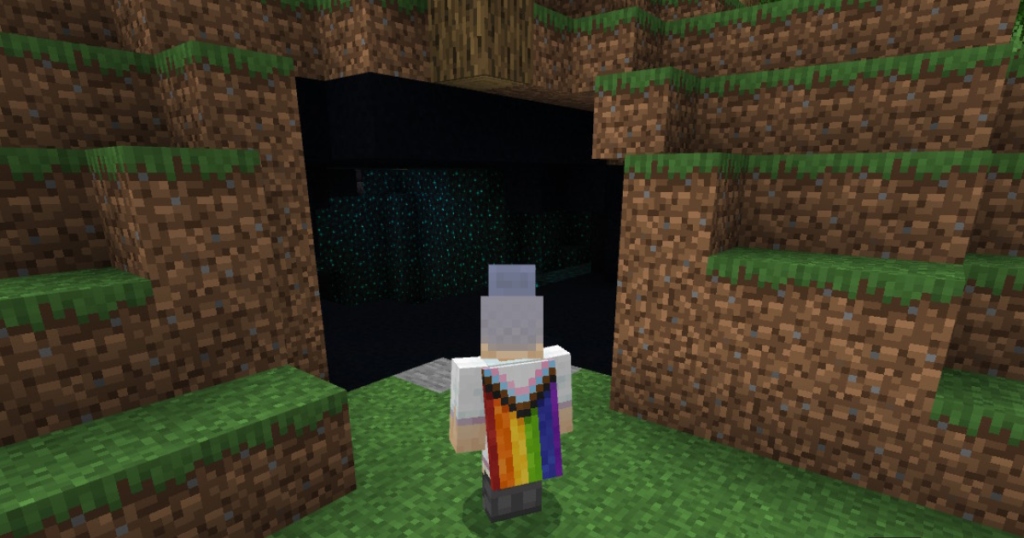
A new client has been working independently on a build and are ready for you to see it. They ask you to approach slowly and not to have any items in your inventory.
Take a big breath and notice what it is like in your body as you imagine approaching this cave. What sensations do you notice? What thoughts might be going through your mind? Consider your own history and approach to the game – is this something that creates apprehension for you or is there a possibility of excitement and wonder? How might you approach this situation differently if you were playing for fun vs. encountering this in a first session?
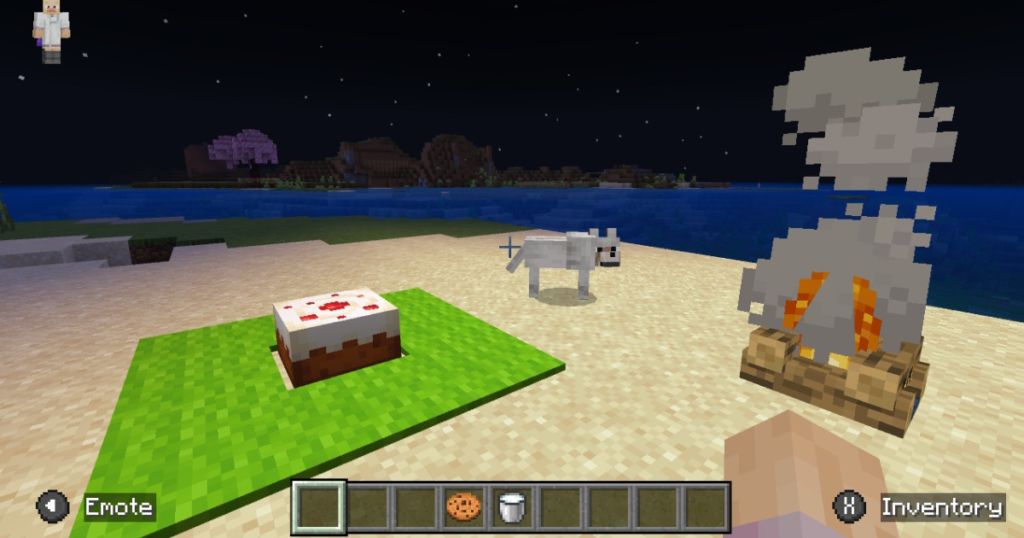
As a mindfulness exercise to help clients become more aware of their experience in the game and in real life, consider these prompts: What would it be like to be in this moment of the game? Notice what you see – both in front of you and in the distance. What smells might you experience? What sounds might you hear? Is there anything you would taste? What would it feel like to walk around this space? Take a big breath and notice what you would like to do next.
Principle 5: How the Game Ends in a Session Is Practice for Endings and Transitions Outside of the Play Therapy Space
Endings for children are hard. Especially when they are doing something they love. Practicing how to move through the big emotions of ending the game in session becomes great practice for how to notice, name, and manage the emotional range of experience with other endings.
Principle 6: Parents and Helping Adults Can Support Their Child in Having a Therapeutic Experience with Minecraft at Home by Being Curious and Learning About the Game Together
Family system support for children in therapy is so important. This principle doesn’t mean that parents or caregivers need to become therapists with interventions they use at home; it acknowledges the benefits of getting caregivers onboard with what is important for their child. That shift in relational attunement is what then becomes therapeutic when playing at home.
Principle 7: The Benefits of Playing the Game Reach Far Beyond the Play Therapy Space and the Digital World of Minecraft
Bringing intentional focus on the child’s experience of the game builds awareness for how the child perceives and relates to their world outside of the game. This includes adapting game mechanics into practical coping skills for real life.
Would this approach also be useful for professionals who are not play therapists, such as counsellors or social workers?
Yes, absolutely. The foundation is in being curious about your clients experience and noticing the quality of the relationship between the game, your client, and yourself. What makes this so powerful is that it is just as adaptable to adult clients who may want to try this in therapy. While the game is the focus of attention, how the client relates to it may be similar to how they relate to so many other things in their life. If an adult is getting frustrated about the mechanics of Red Stone in the game, the work is about their frustration — not how to fix the Red Stone function.
The key to the approach is the intention that is being brought into the game. If the attention is to help the other player learn more about themselves or to work through something, then it can be useful to any helping profession. The same is true for parents when they are playing to connect more with their child. However, there are also times when people might want to “just play.” I joke that when I’m playing my nephews, it’s not with therapeutic intention — I’m going all out!
Minecraft is Another Creative Modality to Help Find Meaning
Ukrainian professionals who work with children primarily deal with the consequences of war: trauma, loss, social isolation, forced displacement, and emigration. In your opinion, how can using Minecraft help in these situations?
It becomes another tool in a clinician’s skillset. For professionals that have guidance and training on how to work with the impact of trauma, loss, social isolation, forced displacement, and emigration, Minecraft is another creative modality to help process, make meaning, express tender emotions, explore changes, and find meaning. The work is still incredible challenging and tender, yet it can become more meaningful and safer as many children recognize the experience of the game as something they can trust and more importantly, control.
Minecraft is another creative modality to help process, make meaning, express tender emotions, explore changes, and find meaning
Many children who have experienced the consequences of war struggle from a disheartening amount of loss of control. Introducing the option of Minecraft, provides an immediate opportunity to reclaim a tiny amount of control; one that I believe, is therapeutic and also a demonstration of the Second Guiding Principle.
I know Ukrainian professionals are holding so much in their work — not only the impact of war on their clients, but for themselves as well. I imagine the shared sense of control and predictability in what the game offers might be grounding for both.
Perhaps you could share a story from your practice using Minecraft that has especially touched you?
When I think about touching moments, the ones that surface are the many instances when the child’s process naturally unfolds over the course of a session, and they take themselves to the emotionally tender places when they are intuitively ready.
I work a lot with grief and childhood bereavement, and I often witness children who begin the session with a seemingly unrelated goal or task, but then it eventually evolves to sharing memories related to their grief or processing significant events that they hadn’t revealed previously. These moments are reminders that through the child’s language of play, they can remove their protective layers and uncover the core emotions and experiences that are wanting to emerge.
Counselors often reference the practice of trusting the process, and I believe in that. However, to make space for the process, I need to come back to my presence as the conduit. The most touching moments seem to be when I get out of my own way and create safety and acceptance for the child to be whoever they need to be in the moment. That is when the child can then express themselves fully through their play.
What would you like to say to Ukrainian professionals who want to use Minecraft or other video games in their practice but simply don’t know where or how to begin?
Trust yourself and trust the relationship with your client. If it is important to your client, your simple interest in the games will be validating and comforting.
Also, whenever possible, look for the connections. I recommend reaching out to colleagues and other professionals using these modalities. If you have friends or acquaintances playing any of the games, coordinate some time to play casually and familiarize yourself with the experience. Anxiety can be expected when doing something new and getting over the initial experience of even just logging in can help clear the way for a more grounded experience.
There is a great sense of connection and support within the community of clinicians using Minecraft and video games. If this is your interest or aspiration—joining others in this shared interest can be a powerful way to stay grounded and connected during adversity.


